

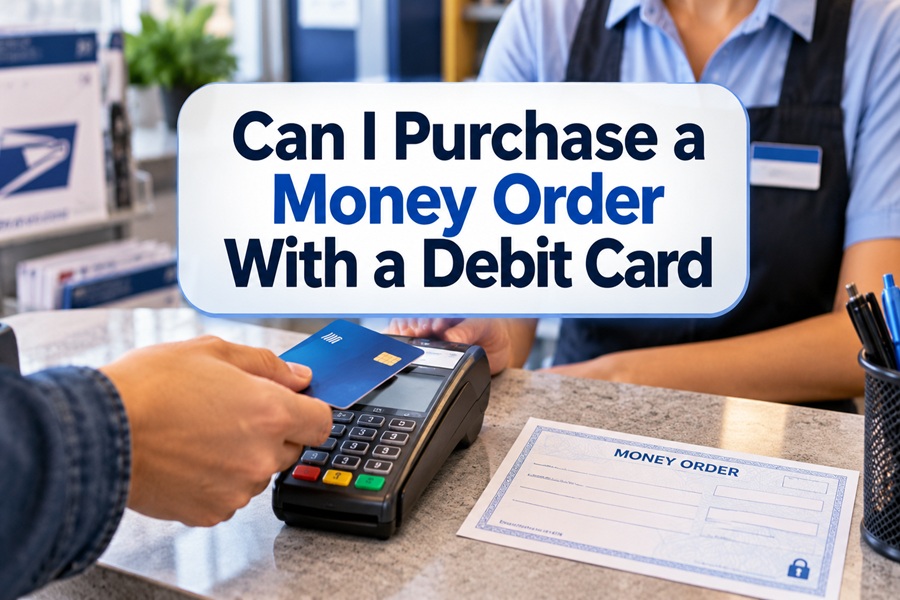
Yes, you can buy a money order with a debit card at most major sellers, including the U.S. Postal Service and Walmart. You usually cannot use a credit card, and a few smaller stores still insist on cash. Knowing those rules before you leave the house saves a wasted trip.
The reason comes down to what a money order is. It is a prepaid payment, meaning the seller needs to receive the full amount upfront. Cash and debit both move money immediately from your own funds. A credit card moves borrowed money, which is why most sellers refuse it.
Where Debit Cards Are Usually Accepted
Policies vary by location, so it is wise to call ahead, but here is the general picture.
| Where to buy | Debit card? | Typical fee | Max per money order |
|---|---|---|---|
| USPS post office | Yes | $2.55 up to $500, $3.60 for $500.01 to $1,000 | $1,000 |
| Walmart (customer service or Money Center) | Yes, usually with PIN | Up to $1 | $1,000 |
| Grocery chains such as Kroger | Usually | Around $1 | Often $1,000 |
| Western Union or MoneyGram agents | Often | Around $1 to $2 | Often $1,000 |
| Banks and credit unions | Usually for account holders | Often around $5 | Varies |
| Some pharmacies and convenience stores | Sometimes cash only | Varies | Often $500 |
Walmart issues its money orders through MoneyGram, while many grocery and convenience locations use Western Union or MoneyGram. The fee is set by the seller, so two stores a mile apart can charge different amounts.
What You Need at the Counter
Bring a few things to make the purchase smooth:
- Your debit card and PIN. Many retailers process money orders as a PIN debit transaction. Signature only cards or prepaid cards may be declined.
- Enough balance for the amount plus the fee. A $600 money order at the post office costs $603.60 total.
- A government issued photo ID. Required at some locations, and generally required for larger purchases.
- The recipient’s exact name and address so you can fill in the money order right away.
Daily Limits Can Trip You Up
Two kinds of limits matter.
The seller’s limit. Most money orders max out at $1,000 each. To send $2,500, you would buy three money orders and pay three fees. Some sellers also cap the total you can buy per day, and Walmart, for example, has a daily limit per customer. Federal anti money laundering rules require sellers to collect identifying information when cash purchases of money orders total $3,000 or more in a day.
Your bank’s limit. Debit cards have daily purchase limits that often fall somewhere between a few hundred and a few thousand dollars. If your money order plus fee exceeds that, the transaction will be declined at the counter. Call your bank or check your app beforehand, and ask for a temporary increase if needed.
Why Credit Cards Do Not Work
A few sellers technically accept credit cards for money orders, but most do not, and there is a good reason to avoid it even when allowed. Card issuers usually treat a money order purchase as a cash advance. That means:
- A cash advance fee, often 3% to 5% of the amount
- A higher interest rate than regular purchases
- Interest that starts immediately, with no grace period
On a $1,000 money order, that can add $30 to $50 in fees before interest. If you need to pay with credit, a different payment method is almost always cheaper.
Debit Card or Cash?
Both work, but each has a small advantage. Paying with debit leaves a clear record in your bank statement showing when and where you bought the money order, which helps if it gets lost. Paying with cash avoids any chance of a declined card due to limits.
Keep the receipt either way. It has the serial number you will need to track or replace the money order.
Filling It Out Correctly
Once you have the money order, fill it out before you leave the counter.
- Write the recipient’s full name on the “Pay to” line.
- Add your name and address in the purchaser section.
- Fill in the memo line with something useful, such as an account or invoice number.
- Sign only where the purchaser signature is required. Do not sign the back, which is for the recipient.
- Detach and keep your receipt.
A blank money order is almost like cash. If it is lost before you fill in the recipient, anyone could use it.
Tracking and Replacing a Lost Money Order
Each issuer offers a way to check status using the serial number and amount. USPS, MoneyGram and Western Union all have online or phone tracking. If a money order is lost or stolen, you can request a replacement or refund, though it usually involves a form, a processing fee and some waiting time. This is exactly why that receipt matters.
Scams That Target Money Order Buyers
Money orders are popular with scammers because they feel official. Watch for these warning signs:
- Someone sends you a money order for more than you are owed and asks you to send back the difference.
- A buyer on a marketplace insists on paying only by money order and wants the item shipped immediately.
- A caller claiming to be from a government agency demands payment by money order.
Fake money orders can bounce days after you deposit them, leaving you responsible for the full amount. When receiving one, you can verify it directly with the issuer using the phone number on the official website, not a number printed on the money order itself.
When a Money Order Is Not the Best Choice
Money orders are great for paying rent to a landlord who will not take cards, sending a payment by mail or paying someone who does not accept personal checks. For amounts over a few thousand dollars, a cashier’s check from your bank is usually simpler, since it covers the full amount in one document. For fast payments between people who trust each other, a bank transfer or payment app may cost less and arrive sooner.
For everyday needs under $1,000, though, walking into a post office or Walmart with your debit card and PIN is one of the easiest ways to send guaranteed funds.