

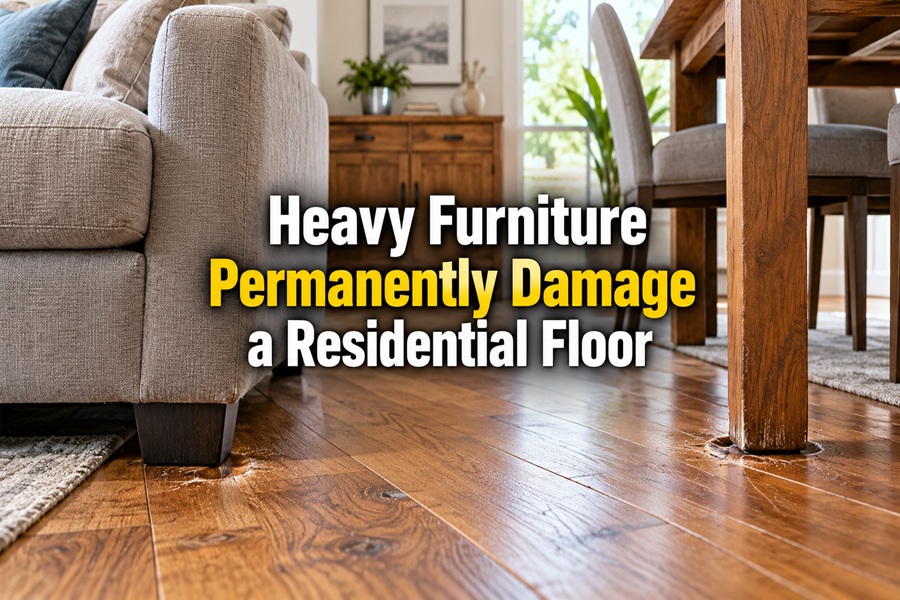
Anyone who has rearranged a living room knows the moment. You slide the sofa away from the wall and find four deep dimples in the carpet, or a set of perfect round dents pressed into the hardwood. Some of those marks fade in a day. Others stay for good.
So yes, heavy furniture can permanently damage a residential floor. Whether it does depends on three things: the type of flooring, how the weight is distributed and how long the load stays in place. The same piano that leaves a temporary dent in carpet can crack ceramic tile or warp a floating vinyl floor.
Why Weight Alone Is Not the Whole Story
What really damages floors is pressure, meaning weight concentrated on a small area. A 300 pound dresser resting on four wide wooden bases spreads its load fairly well. The same dresser on four narrow metal legs focuses that weight onto tiny points, and the floor beneath each leg takes a far bigger hit.
Time matters too. Many flooring materials can bounce back from a brief load. Months or years of constant pressure, however, compress fibers and wood cells past the point of recovery.
How Different Floors Respond
| Flooring type | Typical damage from heavy furniture | Often reversible? |
|---|---|---|
| Carpet | Crushed pile and dents | Usually, if the pile is not matted for years |
| Solid hardwood | Dents and gouges | Sometimes, with steaming or refinishing |
| Engineered hardwood | Dents in the thin top layer | Rarely, limited refinishing |
| Luxury vinyl plank | Permanent indentations, buckling if pinned | Often not |
| Laminate | Chipped edges, cracked locking joints | Usually needs plank replacement |
| Ceramic or porcelain tile | Cracked tiles over weak spots | No, tile must be replaced |
| Natural stone | Cracks, chips, etching under metal feet | Repair possible, often costly |
Carpet
Carpet is the most forgiving. Its fibers compress under weight, but most will stand back up given time and a little help. A popular trick is placing ice cubes in the dents, letting them melt overnight and then fluffing the fibers with a fork or soft brush. Permanent damage tends to happen only when furniture sits in one place for many years or when carpet padding underneath breaks down.
Solid hardwood
Hardwood is surprisingly soft at the surface. Species like pine, American cherry and walnut dent much more easily than hickory or Brazilian cherry. Wood flooring hardness is often compared using the Janka scale, which measures the force needed to press a steel ball into the wood. Higher numbers mean better dent resistance.
Shallow dents in unfinished or lightly finished solid wood can sometimes be raised by laying a damp cloth over the spot and pressing a hot iron on it, which swells the crushed wood fibers. This does not work through thick polyurethane finishes and never fixes torn or gouged wood. Deeper damage usually means sanding and refinishing.
Engineered wood
Engineered flooring has a real wood top layer over a plywood or fiberboard core. It dents much like solid wood, but the wear layer may be too thin to sand more than once or twice, if at all. Dents here are more likely to be permanent.
Luxury vinyl plank and laminate
These popular floors are often installed as floating floors, meaning they are not attached to the subfloor. They need room to expand and contract with temperature and humidity. Very heavy items such as kitchen islands, full bookcases, gun safes or large aquariums can pin the floor in place. When the rest of the floor tries to move, it can buckle, peak at the seams or separate.
Vinyl can also take permanent indentations from narrow legs. Many manufacturers publish load guidelines and recommend wide floor protectors under heavy furniture for exactly this reason.
Tile and stone
Tile itself is extremely strong under compression. The problem is what lies underneath. If tile was set over a subfloor that flexes, or if the installer left hollow spots in the mortar, a heavy load can crack the tile. Metal furniture feet can also chip glazed edges or scratch polished stone.
When the Damage Goes Below the Surface
Most homes are built to handle normal furniture without trouble. Residential codes in the United States typically design living areas for a live load of 40 pounds per square foot and sleeping rooms for 30 pounds per square foot. Those figures account for people, furniture and everyday activity spread across a room.
Trouble starts when very heavy objects concentrate weight in one spot, especially away from walls or support beams. Some examples:
- Large aquariums. Water weighs about 8.3 pounds per gallon, so a 150 gallon tank with gravel, stand and glass can easily exceed 1,500 pounds.
- Pianos. Uprights commonly weigh several hundred pounds, and grand pianos can be heavier still.
- Gun safes. Larger safes often exceed 600 pounds and can pass 1,000.
- Waterbeds and hot tubs indoors. Both concentrate enormous weight.
- Home gym equipment and heavy weight stacks.
Over months or years, these loads can make floor joists sag. Signs include a dip in the floor around the object, doors nearby starting to stick, cracks in drywall below or baseboards separating from the floor. In older homes with smaller joists or past water damage, the risk is higher.
Placing very heavy items near a load bearing wall, perpendicular to the joists, spreads weight over more framing. For anything above about 1,000 pounds, asking a contractor or structural engineer to check the floor is a sensible precaution.
Simple Ways to Protect Your Floors
Most furniture damage is preventable with small habits.
Use wide furniture coasters or cups. They spread weight across a larger area. Look for ones sized well beyond the leg itself.
Add felt pads to every leg. They prevent scratches when furniture shifts and reduce pressure points on hard floors. Replace them when they wear thin or collect grit.
Choose wide, soft casters. Rubber or polyurethane wheels are much kinder to floors than hard plastic or metal.
Lift, never drag. Most scratches and gouges happen during moves. Furniture sliders or a moving dolly protect both the floor and your back.
Rotate and shift furniture occasionally. Moving pieces even a few inches every year or two lets carpet recover and avoids deep impressions.
Use rugs in high load areas. A rug with a quality pad under a dining table or bed absorbs pressure and spreads weight.
Spread extreme loads. For aquariums or safes, a sheet of plywood under a rug or a platform can distribute weight across more floor area.
Repair or Replace?
Light carpet dents, minor scratches and shallow dents in solid hardwood are usually fixable at home or with a professional refinish. Deep vinyl indentations, cracked tile, damaged laminate joints and engineered wood with a worn top layer generally mean replacing the affected pieces. That is why it is smart to keep a box of leftover flooring after any installation.
Structural sagging is a different category altogether and calls for a contractor who can reinforce the framing.
The Bottom Line
Heavy furniture can absolutely leave permanent marks, but in most homes the damage is cosmetic and avoidable. Matching furniture protection to your flooring type, spreading out concentrated weight and paying attention to unusual loads like aquariums or safes keeps both the surface and the structure underneath in good shape for years.