

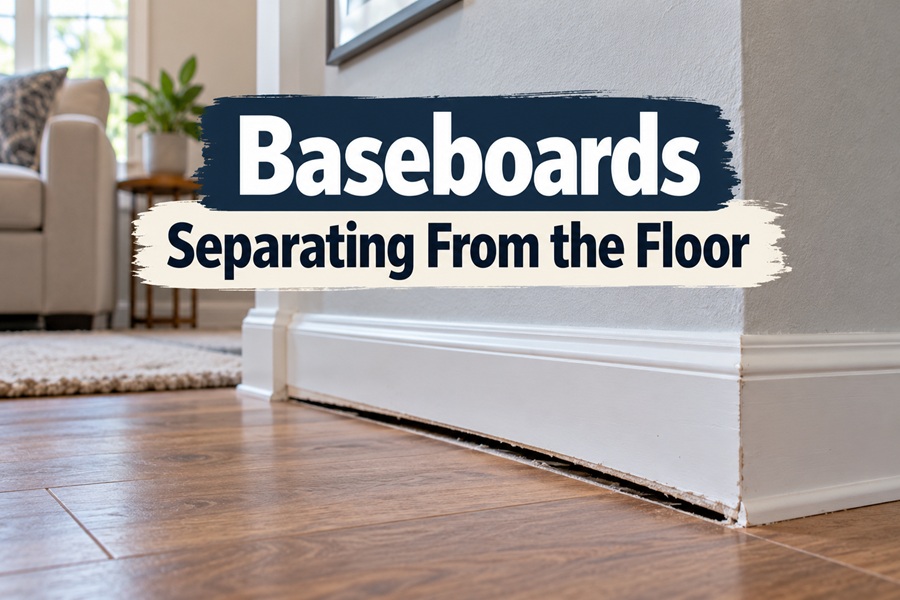
You notice it while vacuuming. A dark line now runs along the bottom of the baseboard where there used to be a tight seam. In one corner you can slide a coin into the gap. It is an unsettling sight, because the first thought most homeowners have is that the house is sinking.
The good news is that most baseboard gaps have ordinary causes. Wood shrinks, floors flex and trim gets nailed in the wrong place. The less good news is that a small number of gaps really are early signs of structural movement or moisture trouble. The trick is learning to tell the difference.
Start by Asking What Moved
A gap only tells you that two things are no longer touching. Either the baseboard pulled up, or the floor dropped away. Figuring out which one moved points you toward the cause.
Press gently on the floor right next to the gap. If it gives or feels springy, the floor is likely deflecting. Now look at the top of the baseboard where it meets the wall. If there is also a fresh crack in the caulk or paint there, the trim itself may be shifting. If the top seam is still perfect and only the bottom opened, the floor is the likelier culprit.
The Everyday Causes
Seasonal wood movement
Wood takes in moisture during humid months and releases it when the air turns dry. Hardwood floors and wood baseboards swell and shrink along with the seasons. A gap that appears in winter, when furnace heat dries the air, and closes again in summer is usually nothing more than this natural cycle.
Floating floors that shift
Laminate and luxury vinyl plank floors are often installed as floating floors. They are not glued or nailed to the subfloor, and installers deliberately leave an expansion gap around the edges so the planks can move. That gap is normally hidden by the baseboard or a small strip of shoe molding. If the flooring shrinks in dry weather or slides slightly, that hidden gap can suddenly become visible.
Baseboards nailed into drywall only
Trim should be fastened into the wall studs and the bottom plate of the wall framing. When installers nail only into drywall, the baseboard has little to hold it. Over time it can loosen, tilt outward or lift as the house expands and contracts. Gaps from this cause tend to appear in random spots rather than along a whole wall.
New construction settling
Homes built in the last year or two go through a settling period. Lumber used in framing dries out, joists shrink slightly and the structure adjusts to its own weight. Small gaps between trim and floors are very common in new builds and usually stabilize after the first full year of heating and cooling seasons.
Causes That Deserve a Closer Look
Sagging floor joists
If the floor near the middle of a room dips away from the baseboards, the joists underneath may be sagging. This can happen when joists are undersized for their span, when heavy loads sit on them for years or when a support post or beam in the basement has shifted. A springy or bouncy floor often goes along with it.
Foundation settlement
When soil under part of a foundation compresses or washes away, that section of the house can drop. Baseboard gaps from foundation movement usually come with other clues:
- Diagonal cracks running from the corners of doors and windows
- Doors that stick, swing open on their own or no longer latch
- Floors that slope noticeably in one direction
- Cracks in the foundation or the basement floor
In areas with expansive clay soil, the opposite can happen too. Soil swells when wet and lifts parts of a slab, which can push floors up in one area and leave gaps elsewhere.
Moisture damage
Water from a slow plumbing leak, a poorly sealed shower or a damp crawlspace can soften subflooring and cause it to sag or warp. In some cases wet wood shrinks as it dries, opening gaps. Look for staining, a musty smell, cupped or warped flooring boards or soft spots underfoot.
Termite or wood rot damage
Termites and rot both weaken wood from the inside. If baseboards feel soft, sound hollow when tapped or crumble when you press a screwdriver into them, the problem goes deeper than a cosmetic gap. Mud tubes along the foundation are a classic sign of termites.
How Big Is Too Big?
There is no universal rule, but these general guides help.
A hairline to about 1/8 inch gap that appears seasonally is usually normal movement.
A gap of 1/4 inch or more, or one that keeps getting wider from month to month, deserves investigation.
A gap that runs consistently along one side of the house, especially with sloping floors or sticking doors, points toward structural movement.
A simple way to track it is to draw a pencil mark or stick a piece of painter’s tape at each end of the gap, then measure and photograph it every few weeks. Stable gaps are rarely urgent. Growing gaps are worth calling a professional about.
Fixing the Gap the Right Way
The fix depends on the cause, and covering up a structural problem only hides the evidence.
For seasonal movement, the simplest solution is to install shoe molding or quarter round along the bottom of the baseboard. Nail it to the baseboard, not the floor, so the floor can still move underneath it.
For floating floors, never caulk or nail the flooring to the trim. Doing so can pin the floor and cause buckling. Shoe molding is again the best way to cover the expansion gap.
For loose baseboards, locate the studs with a stud finder and renail the trim into the framing using finish nails. Fill the holes, caulk the top edge and touch up the paint.
For small, stable gaps, a paintable flexible caulk works on painted trim. Avoid rigid fillers, which crack the next time the house moves.
For sagging joists, a contractor can add sister joists, blocking or an additional support beam. In basements and crawlspaces, adjustable steel support posts are a common fix.
For foundation or soil issues, start with a structural engineer rather than a repair company. An independent engineer will diagnose the problem without having a particular product to sell.
Preventing New Gaps
Keeping indoor humidity fairly steady goes a long way. Many flooring manufacturers recommend keeping relative humidity somewhere around 35% to 55%, and a simple digital hygrometer can tell you where your home sits. A humidifier in winter and a dehumidifier or air conditioning in summer will reduce the shrink and swell cycle.
Outside, make sure gutters drain away from the foundation and the soil slopes away from the house. Water pooling near the foundation is one of the most common triggers of settlement.
The Takeaway
A gap between baseboards and the floor is usually a small, cosmetic sign that wood and flooring are doing what they naturally do. Shoe molding, a few nails or a bead of flexible caulk will typically solve it. But when the gap is wide, growing or paired with cracks, sloping floors or sticking doors, the baseboard is acting like an early warning light. Paying attention to it now can save a far larger repair later.